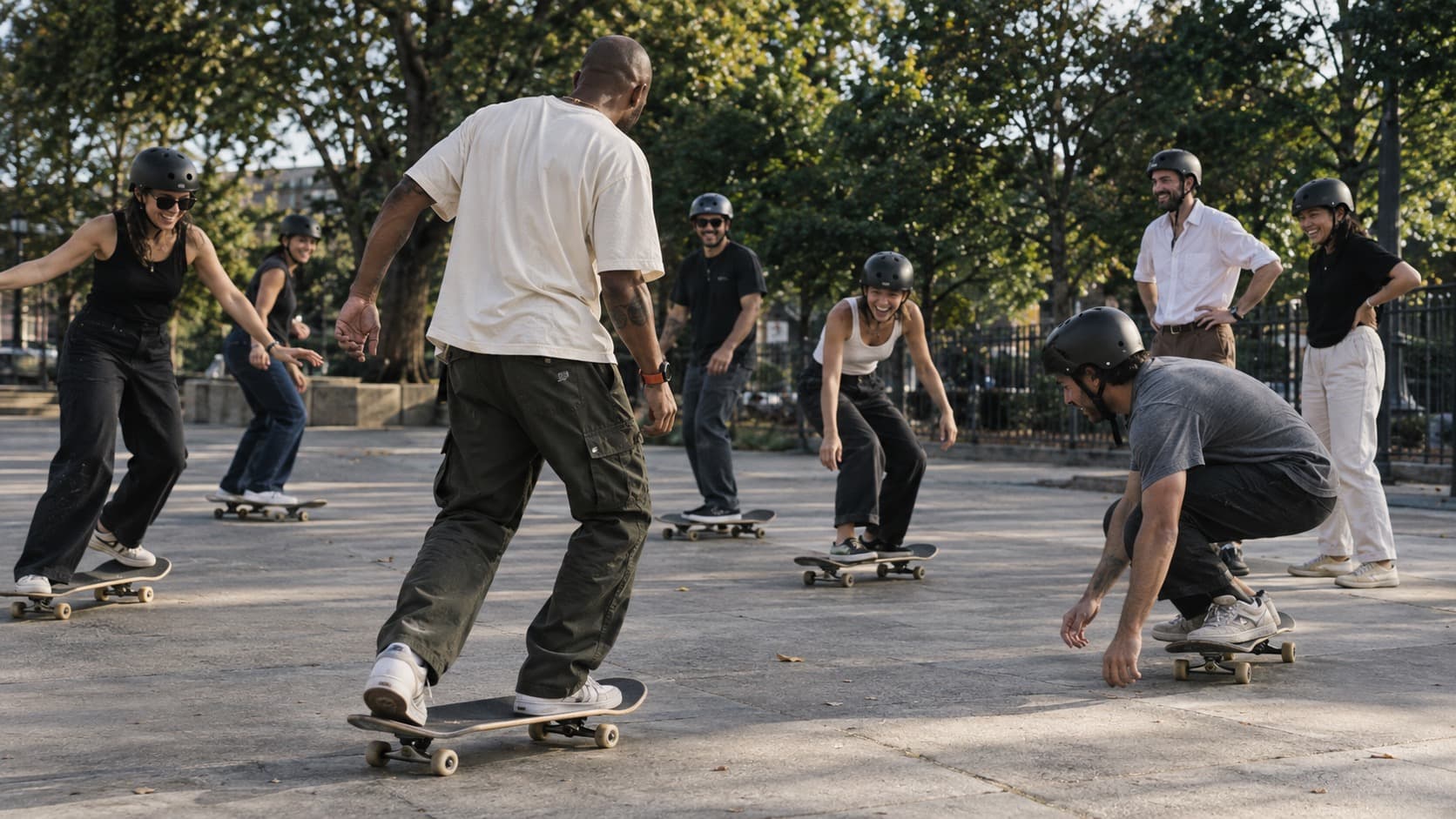
I run a team building activity for a living. I teach corporate groups how to skateboard. So I have a particular interest in this question, and I’ll be upfront about that.
But I also know what I’m competing against, and most of it is bad. The trust falls. The personality quizzes. The mandatory fun that feels like a performance review with snacks. People dread team building because most team building deserves to be dreaded.
The good ones share a few things: everyone participates, nobody needs prior skill, the experience creates something worth remembering, and ideally people are a little bit outside their comfort zone. Here are eight that meet that bar in New York City.
Why does skateboarding work for corporate team building?
Skateboarding strips away every workplace hierarchy in about thirty seconds. Research from the Institute for Corporate Productivity found that companies promoting collaborative work are five times more likely to be high-performing. When nobody on the team can fake competence—your CFO wobbles just like your newest hire—real connection shows up fast.
This is mine, so I’ll say why I think it works and you can decide. When your VP of Engineering steps on a skateboard for the first time, they look exactly as uncertain as the newest intern. Nobody has an advantage. Nobody can fake it. That’s the entire point.
I’ve been teaching for over 20 years and I’ve run sessions for groups of 5 to 20 people. Everyone learns to stand, push, and turn. Some people surprise themselves. Some people fall and get back up in front of their boss, which turns out to be worth more than any icebreaker.
Sessions start at $800 for groups up to 10. I bring all the boards and safety gear. Indoor and outdoor locations across NYC and Westchester.
What makes improv comedy a good team building activity?
Improv builds the communication muscle most team building ignores. A study from MIT’s Human Dynamics Lab found that the most productive teams have members who speak in short turns and face each other directly—exactly what improv games train people to do. Two hours of structured play often shifts meeting dynamics for months.
Upright Citizens Brigade, Magnet Theater, and the PIT all run corporate improv sessions. The format is usually 2 hours of structured games where people practice saying “yes, and” instead of “well, actually.”
Improv works because it’s impossible to be self-conscious for two straight hours. At some point, you just start playing. The skills translate directly to meetings and brainstorms, though nobody frames it that way during the session. That’s what makes it effective.
Expect $75 to $125 per person. Most venues handle groups of 10 to 30.
Are cooking competitions good for team bonding?
Cooking competitions create natural leadership moments that no icebreaker can replicate. Research from Cornell University found that teams who eat together perform significantly better on collaborative tasks. When your group splits into smaller teams and builds a meal under time pressure, you learn who your coworkers really are.
Places like Brookfield Place’s cooking studios and The Brooklyn Kitchen run team-based cook-offs. Your group splits into smaller teams, gets a set of ingredients, and has to produce a meal together under time pressure.
It works because the roles emerge naturally. Someone takes charge of the protein. The person who never talks in meetings turns out to have strong opinions about plating. You learn things about your coworkers that a conference room will never surface.
Runs $100 to $175 per person depending on the venue and menu. Groups of 8 to 24.
Can you go kayaking as a team activity in NYC?
Kayaking gives teams something most NYC activities can’t—genuine quiet and a change of perspective. A University of Utah study found that spending time in nature improves creative problem-solving by up to 50%. Paddling the Hudson next to the skyline resets people in ways a conference room never will.
Manhattan Community Boathouse and Brooklyn Bridge Park Boathouse both offer group kayaking. The free public sessions work for casual outings. For a structured team experience, book a guided paddle with a private outfitter on the Hudson or East River.
There’s something about being on the water next to Manhattan that resets people. The skyline is right there, the same one everyone sees from their office window, but you’re looking at it from a kayak. The change in perspective is literal. Conversations happen on the water that don’t happen in the office.
Free for the public boathouses (first come, first served, seasonal). Private group paddles run $50 to $100 per person. Best from May through October.
Is indoor rock climbing a good team building option?
Indoor climbing turns individual effort into group problem-solving naturally. A University of Essex study found that exercising in social environments increased both motivation and enjoyment by over 30%. People end up coaching each other through routes without being told to—that’s collaboration you can’t manufacture in a meeting room.
Brooklyn Boulders, The Cliffs, and Steep Rock all run corporate group sessions. Bouldering (no ropes, shorter walls, thick crash pads) is the best format for teams because everyone can climb at their own pace and help each other figure out routes.
Like skateboarding, climbing is one of those activities where watching someone else try a problem and fail makes you want to try it yourself. The competitive energy is friendly by default. People end up coaching each other without being told to.
Day passes run $25 to $40 per person plus shoe rental. Private group bookings with instruction are $50 to $80 per person.
What about art or pottery studios for a team outing?
Art studios work for teams that need bonding without adrenaline. Research published in the American Journal of Public Health found that creative arts participation significantly reduces stress and anxiety. When people work with their hands at a slower pace, conversations happen that high-intensity activities don’t leave room for.
Color Me Mine, Pottery Bar, and a handful of independent studios in Brooklyn and the Lower East Side run group sessions where everyone makes something. Pottery wheels, canvas painting, ceramics, screen printing. You leave with an object you made.
The pace is slower than other options on this list, which is the appeal for some teams. People talk while they work. It’s low pressure. The creative teams tend to love these; the engineering teams tend to be skeptical going in and surprised by how much they enjoyed it coming out.
$45 to $85 per person including materials. Most studios cap group bookings at 20 to 25 people.
Do walking food tours count as team building?
Walking food tours are the lowest-risk team building option in New York. Research from Oxford University found that eating socially increases feelings of closeness and overall satisfaction. Nobody is going to hate a guided walk through the best food in a neighborhood—and for mixed-energy teams, that reliability matters.
Companies like Foods of NY Tours and Scott’s Pizza Tours run guided walks through specific neighborhoods. You eat at 5 or 6 spots, walk a few miles, and hear the history of the area between stops.
This is the safest choice on the list. Nobody is going to hate it. The food gives people something to talk about without forcing conversation. The walking keeps it moving. For teams where some people are more introverted or where the group has a big age range, a food tour is a solid bet.
$65 to $100 per person for a 2 to 3 hour tour. Groups of 10 to 25. Private tours can be customized for larger groups.
What about volunteering as a team building activity?
Volunteering bonds teams around purpose instead of novelty. A Deloitte survey found that 89% of employees believe companies sponsoring volunteer activities offer a better overall work environment. Your team finishes the day having done something that mattered to someone beyond the company—and people remember that differently.
New York Cares, Habitat for Humanity NYC, and local community gardens all coordinate corporate volunteer days. Park cleanups, meal packaging, community garden builds, school supply sorting. The format is typically a half day with a clear deliverable: you show up, you work, and you can point at what you did when you’re done.
This works differently from the other options. The bonding is a side effect, not the goal. Your team finishes the day having done something that mattered to someone beyond your company. People talk about that differently than they talk about the pizza tour.
Often free or minimal cost ($10 to $20 per person for materials). Groups of any size. Book through the organization 3 to 4 weeks ahead.
How do you pick the right team building activity for your group?
The right activity depends on three things: participation design, memorability, and whether it flattens the hierarchy. According to Harvard Business Review, the most effective team activities require everyone to contribute and put experienced members on equal footing with newcomers. Start there and most of the bad options eliminate themselves.
Start with whether everyone has to participate or whether people can watch. The activities where someone can sit on the sideline are the ones where someone always does. Choose things that are all-in by design.
Then ask whether your team will remember it in six months. If the answer is “probably not,” the activity is fine but it’s not team building. It’s just an outing. Team building requires some element of shared challenge or shared creation.
And ask whether it flattens the hierarchy. The best team building puts the CEO and the new hire on equal footing. If someone’s existing skills give them an advantage, the activity rewards the wrong thing.
Skateboarding, improv, and cooking score highest on all three. Climbing and volunteering are close behind. Food tours and art are lower-intensity but work well for teams that need a softer entry point.
Common questions
How much do team building activities cost in NYC?+
Most run $50 to $150 per person for a 2 to 3 hour experience. Skateboard team building sessions start at $800 for groups up to 10. Improv workshops run $75 to $125 per person. Cooking competitions are $100 to $175 per person. Kayaking and rock climbing range from $50 to $100 per person. Volunteer projects are often free or under $20 per person.
What size groups work for team building?+
It depends on the activity. Skateboard sessions work best with 5 to 20. Improv handles 10 to 30. Cooking competitions cap around 24. Climbing and kayaking work for 8 to 40. Smaller groups (under 15) tend to get more out of activities where everyone participates at the same time.
What are good team building activities for remote teams meeting in person?+
Choose activities that create shared physical experiences rather than discussion-based exercises. Skateboarding, improv, cooking, and outdoor adventures all work because everyone starts at the same level and the experience itself does the bonding. Skip anything that rewards existing friendships or lets people sit out.
How far in advance should I book team building in NYC?+
At least 2 to 3 weeks for most activities. Popular cooking venues and outdoor experiences during summer fill up 4 to 6 weeks out. Skateboard sessions with Leon Toppin can often be arranged with 1 to 2 weeks notice depending on group size and season.